Did We Just See the Future of Cars?
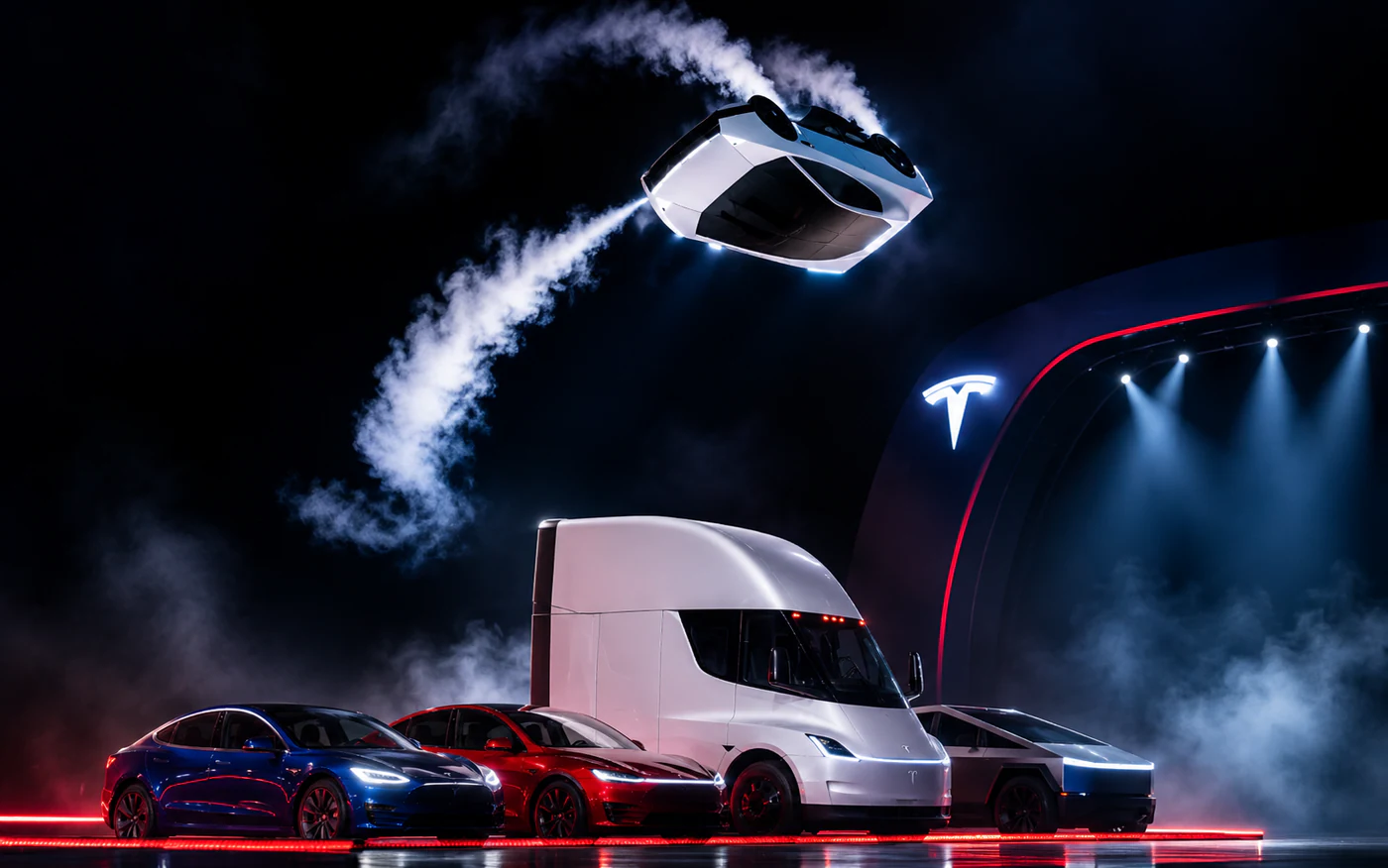
Imagine watching a white sports car drive up a giant curved ramp. It climbs higher, turns completely upside down, and suddenly launches into the air.
Then something even stranger happens.
The car rotates above the ground, releases a cloud of white vapor, and lands on its wheels.
No movie tricks. No computer-generated spectacle. This was Tesla's extraordinary Roadster demonstration on October 15, 2026, at a SpaceX testing facility in Texas.
And it left people asking one question.
Are flying cars finally becoming real?
A Sports Car That Refuses to Stay on the Ground
Tesla first introduced its second-generation Roadster concept in 2017. It promised astonishing acceleration, dramatic styling, and performance that seemed almost impossible.
Then the years passed.
The Roadster became one of the most anticipated and delayed vehicles in the electric-car world.
But when Tesla finally revealed its redesigned prototype, it wasn't simply another fast electric sports car.
It was something far stranger.
The new Roadster featured a sharp, aircraft-inspired body, dramatic doors, and technology developed with SpaceX.
During the demonstration, Elon Musk described what the machine could do:
“It's going to take the fun meter to 11 out of 10.”
That was quite a promise.
And then the car started doing things automobiles aren't supposed to do.
How Do You Make a Car Fly?
The secret isn't a pair of wings.
It's a combination of powerful fans and compressed-gas thrusters.
The Roadster uses a suction system beneath its body to create a low-pressure area, helping hold the car against the road. During the demonstration, this allowed the prototype to climb a curved structure and travel upside down.
Then came the really spectacular part.
SpaceX-derived thrusters released bursts of high-pressure gas, providing enough force to propel the car into the air and help control its movement.
Think of the small jets used to maneuver spacecraft, except attached to a sports car.
Musk told the audience:
“It can basically fly like a rocket.”
And for a brief moment, that's exactly what it appeared to do.
But there's an important distinction. The prototype demonstrated controlled airborne stunts, not sustained flight across a city. This is not yet the flying car of everyday science fiction.
Faster Than You Can Blink?
Flying wasn't the only surprise.
Tesla also demonstrated extraordinary acceleration, claiming that the Roadster reached 60 miles per hour in approximately 0.81 seconds.
That's less than a second to reach highway speed.
The company says its thrusters can help the car accelerate beyond what ordinary tires and electric motors can achieve alone.
But the prototype's performance isn't the same as independently verified production-car performance.
For now, those astonishing numbers belong to a demonstration vehicle.
Still, watching a car accelerate almost instantly is enough to make even experienced automobile enthusiasts look twice.
A Design Inspired by Fighter Jets
The Roadster's appearance is almost as interesting as its engineering.
Tesla says its redesigned body takes inspiration from aircraft such as the SR-71 Blackbird and the F-35 fighter jet.
The result is a low, angular white machine that looks closer to a futuristic concept car than a conventional roadster.
Its sculpted surfaces, active rear wing, and dramatic proportions suggest speed even when it's standing still.
And unlike the original Roadster concept, this design was created with the possibility of airborne movement in mind.
It's a fascinating question for automobile designers.
What should a car look like when the road is no longer its only environment?
Can You Actually Buy One?
Not the flying prototype you saw in the demonstration.
Tesla has outlined three versions of the new Roadster.
The Performance model is intended for conventional road use. The Thrust version adds rear-mounted gas thrusters for extreme acceleration. And the Rocket version is designed to include additional thrusters capable of aerial maneuvers.
That last version is planned as an invitation-only vehicle.
Tesla is targeting production in 2028, but its long history of Roadster delays makes that date a goal rather than a guarantee.
And even if the technology works, regulations, safety requirements, and practical limitations present enormous challenges.
A car that can leap into the air is one thing.
A car that can safely fly over everyday traffic is another.
The Future Just Got a Little Stranger
For generations, people have imagined flying automobiles.
They appeared in cartoons, science-fiction films, futuristic illustrations, and the dreams of designers who believed roads might someday become optional.
Now Tesla has demonstrated a vehicle that briefly leaves the ground under its own power and controls its movement in midair.
It isn't a practical flying car yet. It may never become one in the way people imagine.
But perhaps the most interesting part of the new Roadster isn't how fast it accelerates or how high it can glide.
It's that engineers are seriously exploring something that once belonged almost entirely to science fiction.
And that makes the photograph of a white Tesla floating above the ground feel like more than an automotive stunt.
It feels like a glimpse of a possible future.
For more than a century, automobiles have been designed to follow the road. The next great design question might be what happens when they no longer have to.