Hiroshi Nagai, The Artist Who Painted an Endless Summer
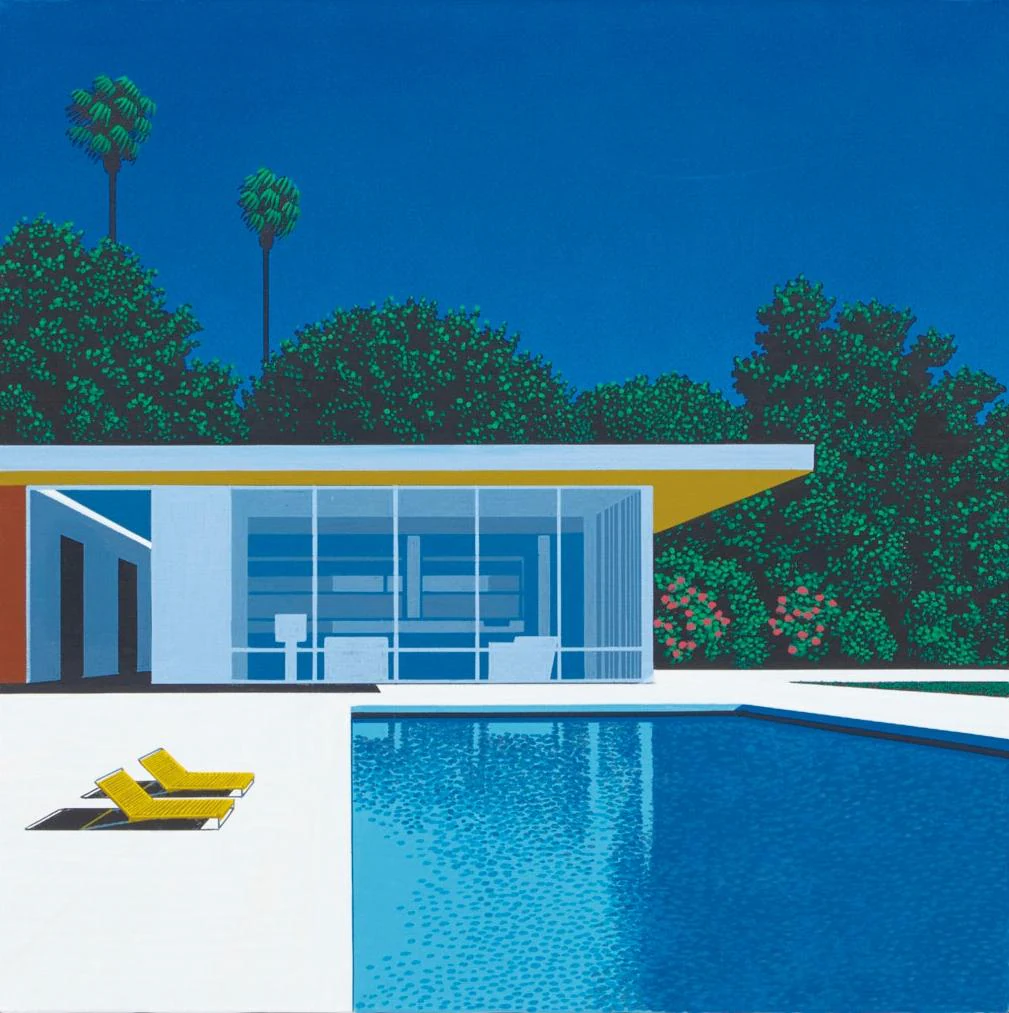
Palm trees, swimming pools, empty streets, and impossibly blue skies. How a Japanese illustrator turned his vision of paradise into one of the most recognizable aesthetics in pop culture.
Imagine a place where summer never ends.
The swimming pools are always perfectly blue. Palm trees stand motionless against cloudless skies. The streets are spotless, the buildings glow in the afternoon sun, and somehow, there isn't a single person in sight.
It looks like California in 1982. Or Miami. Or a tropical resort that might have existed somewhere in a forgotten travel brochure.
Welcome to the world of Hiroshi Nagai.
For decades, the Japanese artist has been painting a version of paradise that feels strangely familiar, even if you've never visited anywhere like it. His illustrations became inseparable from Japan's city pop music scene in the 1980s, and today they're finding an entirely new audience around the world.
But the story of how he arrived at this unmistakable style begins thousands of miles away from those imaginary swimming pools.
A Japanese artist discovers America
Born in Tokushima, Japan, in 1947, Nagai began his career in graphic design before moving into illustration.
Then came a journey that would change everything.
In 1973, he traveled across the United States for 40 days. California's brilliant sunlight, automobiles, architecture, and deep shadows made a lasting impression. A trip to Guam the following year introduced another recurring feature of his paintings: tropical palm trees.
The America Nagai encountered was unlike the Japan he knew. It was spacious, colorful, and filled with scenes that seemed almost cinematic.
Rather than simply reproduce the places he visited, Nagai began building an idealized world from his memories, photographs, magazines, and imagination.
In a 2025 conversation with Sato Gallery, he explained the thinking behind his pictures:
"Scenes I’d like to see exist."
That simple idea captures the magic of his work. Nagai wasn't necessarily painting real destinations. He was painting places he wished were real.
The sound of summer gets a picture
By the late 1970s and early 1980s, Japan was experiencing a cultural and economic transformation. A sophisticated new sound was emerging, blending pop, funk, soul, jazz, and American soft rock.
It became known as city pop.
The music sounded like driving along a coastal highway with the windows down. It was polished, relaxed, and optimistic.
And Nagai's paintings looked exactly how it felt.
His breakthrough came through his collaboration with musician Eiichi Ohtaki. The artwork associated with Ohtaki's celebrated 1981 album A Long Vacation became one of the defining images of the era.
Interestingly, Nagai wasn't chasing the city pop movement.
As he recalled in his Sato Gallery interview:
"City pop came to me — musicians approached me for cover art."
The relationship between his art and Ohtaki's music was unusually close. In a 2015 interview with Kaput magazine, Nagai explained that his paintings had actually helped inspire the songs.
The result was a rare creative partnership where the music and images seemed to belong to the same imaginary world.
Why is nobody ever there?
Look closely at Nagai's paintings and you'll notice something unusual.
There are almost never any people.
The swimming pools are empty. The cars appear parked. The beaches look untouched. Everything seems to be waiting for someone to arrive.
This absence gives his work a peculiar atmosphere. It's peaceful, but sometimes a little mysterious. Like the opening scene of a movie before the story begins.
Nagai has explained that the absence of people wasn't originally a carefully planned artistic statement. It emerged naturally in his compositions.
And perhaps that's why the paintings are so inviting.
Without characters occupying the scene, the viewer becomes the visitor. That empty chair beside the pool could be yours. That quiet street could be somewhere you're about to explore.
His paintings leave just enough room for your imagination to finish the picture.
The secret behind those impossibly blue skies
Nagai's visual language is deceptively simple.
Strong geometric shapes. Clean architecture. Carefully positioned palm trees. Sharp sunlight. Deep shadows. And, of course, that unforgettable blue.
His approach combines the clarity of graphic design with the atmosphere of painting.
In a 2022 interview with Uniqlo, he described building his skies by first applying blue paint, then using an airbrush to introduce white near the horizon and gradually layering lighter blues.
The effect is almost hypnotic.
His landscapes can look so precise that they resemble digital illustrations, yet they have the softness and warmth of traditional painting.
It's a style that feels both vintage and remarkably modern.
An old summer finds a new generation
For years, Nagai's work was closely associated with Japanese records, advertisements, and printed illustrations.
Then the internet gave those images a second life.
As city pop found international listeners through streaming platforms and online music communities, the artwork associated with the genre traveled with it.
A generation born long after the 1980s began discovering the same blue skies and tropical landscapes that had appeared on Japanese record sleeves decades earlier.
His aesthetic also found a natural connection with vaporwave and other internet-born visual movements fascinated by retro design, nostalgia, and imagined versions of the past.
Yet Nagai himself seems less interested in nostalgia than many of his admirers.
In his 2025 interview, he explained that his vision of summer had remained essentially unchanged since the 1980s.
The world had changed around his paintings. The paintings themselves had no reason to change.
Somewhere, it's still summer
There is something comforting about Hiroshi Nagai's art.
His paintings don't demand an explanation. They don't insist on a complicated message. They simply invite you to look at a beautiful place and stay for a while.
In his conversation with Sato Gallery, Nagai reflected on the different emotions people bring to his work:
"If it brings them a sense of well-being, that’s enough."
Maybe that's why his images continue to resonate.
A swimming pool under a blue sky. A tall palm tree. The last light of a perfect afternoon.
In Nagai's world, there's no rush to get anywhere.
Summer is still waiting for you.