Is the Golden Ratio the Secret Formula for the Perfect Photograph?
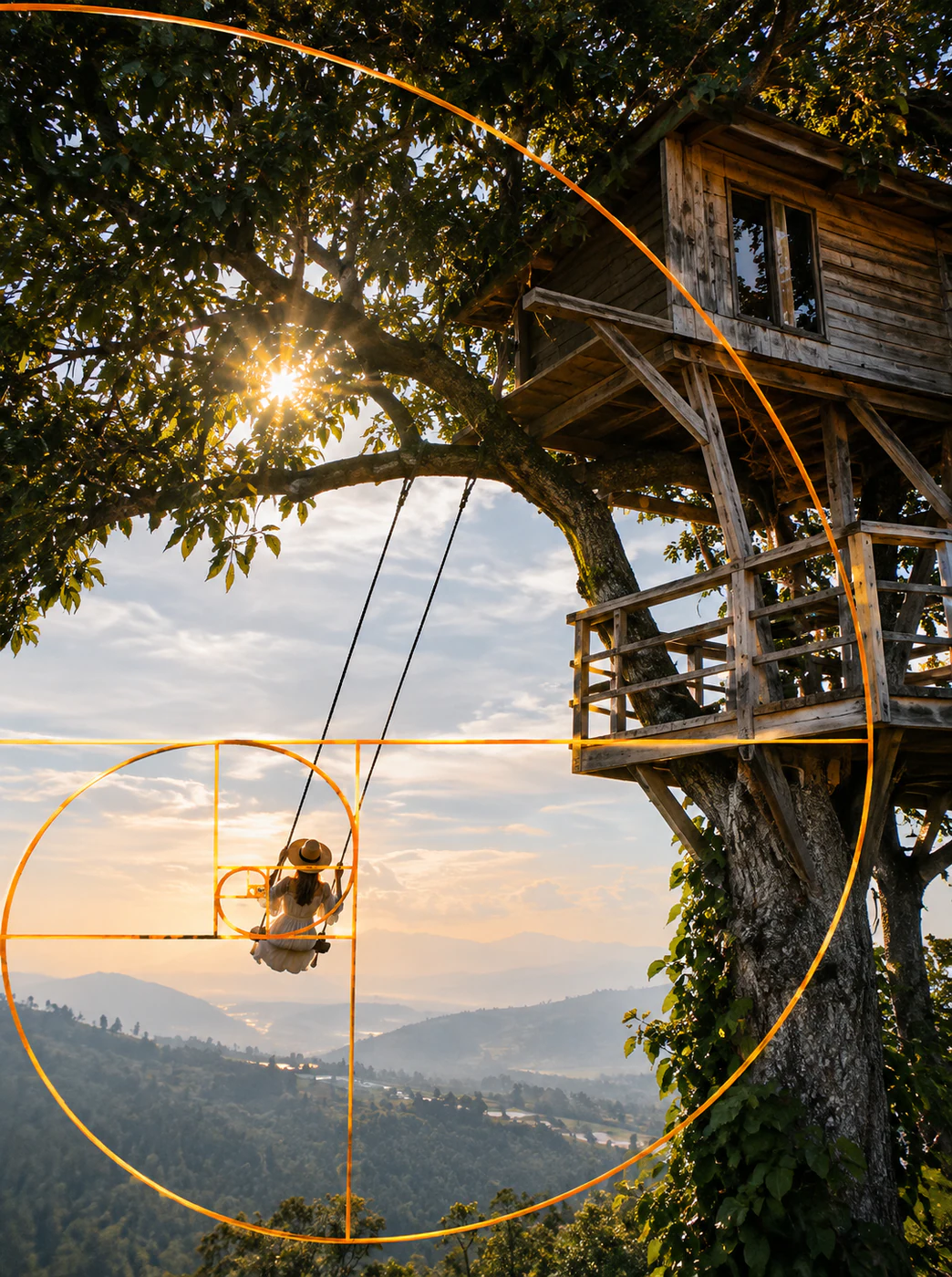
For centuries, artists and mathematicians have been fascinated by a mysterious number. Could it also be the secret to a beautiful photograph?
Some photographs just seem to work. Your eyes move effortlessly through the scene, the subject feels perfectly placed, and everything appears to fall into balance.
Is it instinct, artistic talent, or could mathematics have something to do with it?
Meet the golden ratio, a mathematical proportion of approximately 1.618 that has inspired artists, designers, and photographers for generations.
The Magic Number 1.618
Imagine drawing a rectangle, then dividing it into a square and a smaller rectangle. If the proportions are just right, the smaller rectangle has the same proportions as the original.
Repeat the process, and you can draw a sweeping spiral through the resulting squares.
This is the familiar golden spiral, a shape often used to illustrate the golden ratio.
Similar mathematical patterns appear in nature, particularly in the arrangement of leaves, seeds, and certain spiraling forms. But the golden spiral itself is a mathematical construction, not a universal blueprint for everything beautiful.
The Spiral That Guides Your Eye
Photographers can use the golden spiral as a composition guide.
Instead of placing the subject directly in the center, they might position it near the spiral's tightest curve, allowing the surrounding scenery to lead the viewer toward it.
Think of a winding staircase photographed from above, a wave curling toward the shore, or a portrait where the person's face sits naturally at the center of a sweeping composition.
The result can feel surprisingly balanced, even when the subject is nowhere near the middle.
Did the Great Artists Know Something We Don't?
The golden ratio has frequently been associated with famous paintings, classical architecture, and even Leonardo da Vinci.
But many of these connections are debated. Just because a golden rectangle can be drawn over a painting doesn't mean the artist deliberately used one.
And that brings us to the most interesting question.
Does the Golden Ratio Really Make Photographs More Beautiful?
Not necessarily.
Beauty is much more complicated than a single number. Lighting, color, emotion, timing, and the story behind an image all influence how we experience it.
A perfectly proportioned photograph can still be boring. An imperfect snapshot can become unforgettable.
The golden ratio is best understood as a creative tool, not a rule that guarantees beauty.
Try It Yourself
The next time you take a photograph, experiment with placing your subject slightly off-center. Look for curves, pathways, or architectural lines that naturally draw attention toward it.
You can also explore PhiMatrix.com a visual design tool that helps users examine golden-ratio proportions and overlays in photographs, artwork, and other designs.
You might discover an entirely new way of seeing the world.
And perhaps that's the real magic of the golden ratio. It doesn't tell us what makes something beautiful.
It simply encourages us to look a little closer.